


YottaDB as a Creative Platform: Experimental Video Art at Scale
Jordan Lenchitz
We thank Jordan Lenchitz for his first guest blog post, and hope there are many more to follow. If you would like to post on the YottaDB blog please contact us at info@yottadb.com.
When it comes to experimental video art the database you choose shapes what is possible, what is fast, and what is sustainable.
My Creative Process
Step one: global generation. I build MUMPS routines that encode my compositional ideas into global subscripts. These routines embody the algorithmic decisions that define a unique work of experimental video art. Each run of a MUMPS routine generates thousands of nodes representing frequencies, timings, spatial coordinates, color values, and whatever my experimental video art requires.
Step two: replication filters. My generated globals flow through replication filters to apply the “business logic” for the experimental video art on SI replicas.
Step three: relationalization. SQL queries run on the replicas to map the global subscript structure onto relational tables. This is where the raw algorithmic output becomes queryable: I can ask “give me all frequencies between 400 and 500 hertz” or “find the points where two voices intersect” without regenerating any globals.
Step four: connection to Pure Data. I connect to the SQL database from Pure Data, the realtime visual programming environment, using its PostgreSQL connector. Pure Data reads the relationally mapped data and renders it, synthesizing the audio, driving the visuals, creating the final artwork. The database becomes the bridge between algorithmic conception and sensory experience.
Why YottaDB
I could have used a relational database for steps three and four and stopped there (and many people do!) but then I would have lost steps one and two. I would have written the algorithms in some other language, serialized them into SQL, and given up the expressiveness of MUMPS for algorithmic composition. YottaDB gives me the whole stack. MUMPS is extraordinarily good at manipulating hierarchical data, which is what deeply nested algorithmic composition actually looks like. Global subscripts are how these systems want to be written, not a workaround for something else. The replication layer means I don’t have to choose between computational power and queryability. I can generate at full speed in one environment and expose relational views to Pure Data without exporting or rebuilding anything. The separation between the algorithmic engine and the consumer interface happens at the database layer, not in application code. Performance matters too; generating thousands of data points, running replication filters across all of them, then querying subsets in real time as Pure Data renders is not a trivial workload and YottaDB has no trouble with it.
The Why Behind the Why
Databases are opinionated because they encode assumptions about what data looks like, how you access it, what’s fast, and what’s slow. Most of them assume relational structure from the start but YottaDB assumes you might want hierarchical algorithmic structure first and relational views of that same data later. For my creative work, this is the whole ballgame. Algorithmic composition lives in the hierarchical world where relations come later (as a view!). A database that forces you to think relationally first takes away the tools that make algorithmic thinking natural. YottaDB lets MUMPS be MUMPS and SQL be SQL in the same system, without translation layers or duplication. That has shaped every work of experimental video art I’ve made since 2023. If you’re building systems where algorithmic or hierarchical data generation matters and you need relational queryability later, YottaDB is worth a serious look. It trusts you to think in the structures that actually fit your problem and it will let you make strange and beautiful things.
About Jordan Lenchitz
Jordan Lenchitz is a MUMPS programmer and experimental video artist based in Verona, Wisconsin. He holds degrees in mathematics, French, and music composition from Indiana University and is completing a PhD in music theory and composition at Florida State University. (His dissertation examines listening to a cappella vocal musics as an extension of Eleanor Gibson‘s ecological approach to perception.) His creative work centers on extended just intonation and algorithmic composition as well as contributions to open source projects. You can listen to his video work and contact him through his website.
Credits
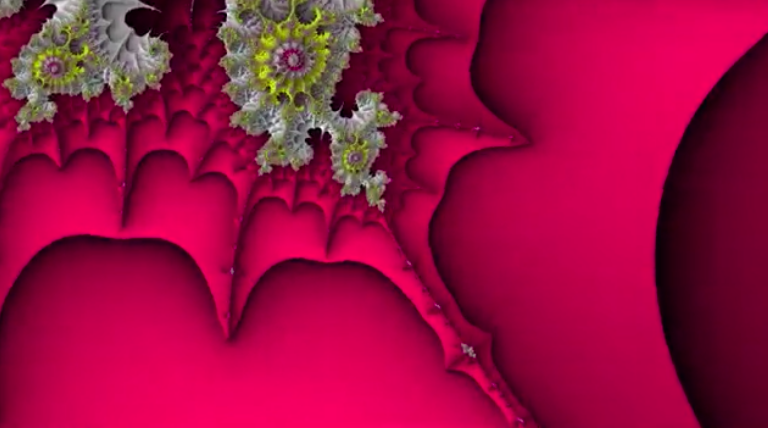
- Screenshots from pareidolia and in memoriam ben johnston used with permission of Jordan Lenchitz.
Published on April 21, 2026